Willemstad Walking Guide: Punda, Otrobanda and the Queen Emma Bridge
Willemstad is a walker's city: two historic districts facing each other across a harbor, stitched together by a floating bridge that swings aside for passing ships. In a half day on foot you cover the colored waterfront, the forts, the floating market and the street-art quarters without ever needing a car.
Choose a history walk or a food route as the main activity, then leave time to wander.
Quick Take: The two-hour Punda and Otrobanda walk offers local context; the food outing is a separate four-and-a-half-hour plan. Explore Willemstad Guided Walk
The first thing that surprises people about Willemstad is that the bridge moves. The Queen Emma pontoon bridge floats on the water, and several times a day it swings open like a gate to let ships pass into the harbor, pedestrians and all stepping off first. It is a fitting introduction to a capital that rewards curiosity and legs over any other way of getting around.
The old town splits into two halves, Punda and Otrobanda, each with its own character, joined across the harbor mouth by that swinging bridge. This guide walks you through both, plus the restored quarters of Pietermaai and Scharloo, with a half-day route, the best photo spots, and honest answers on whether it is all as walkable and safe as it looks.
Is Willemstad walkable, and how long do you need?
Yes, Willemstad is one of the most walkable capitals in the Caribbean, and a half day covers the essentials. The two old-town districts sit either side of a harbor entrance joined by the pontoon bridge, all flat and compact. Give it three to four hours for the highlights, or a full day if you want the museums, food and street-art quarters too.
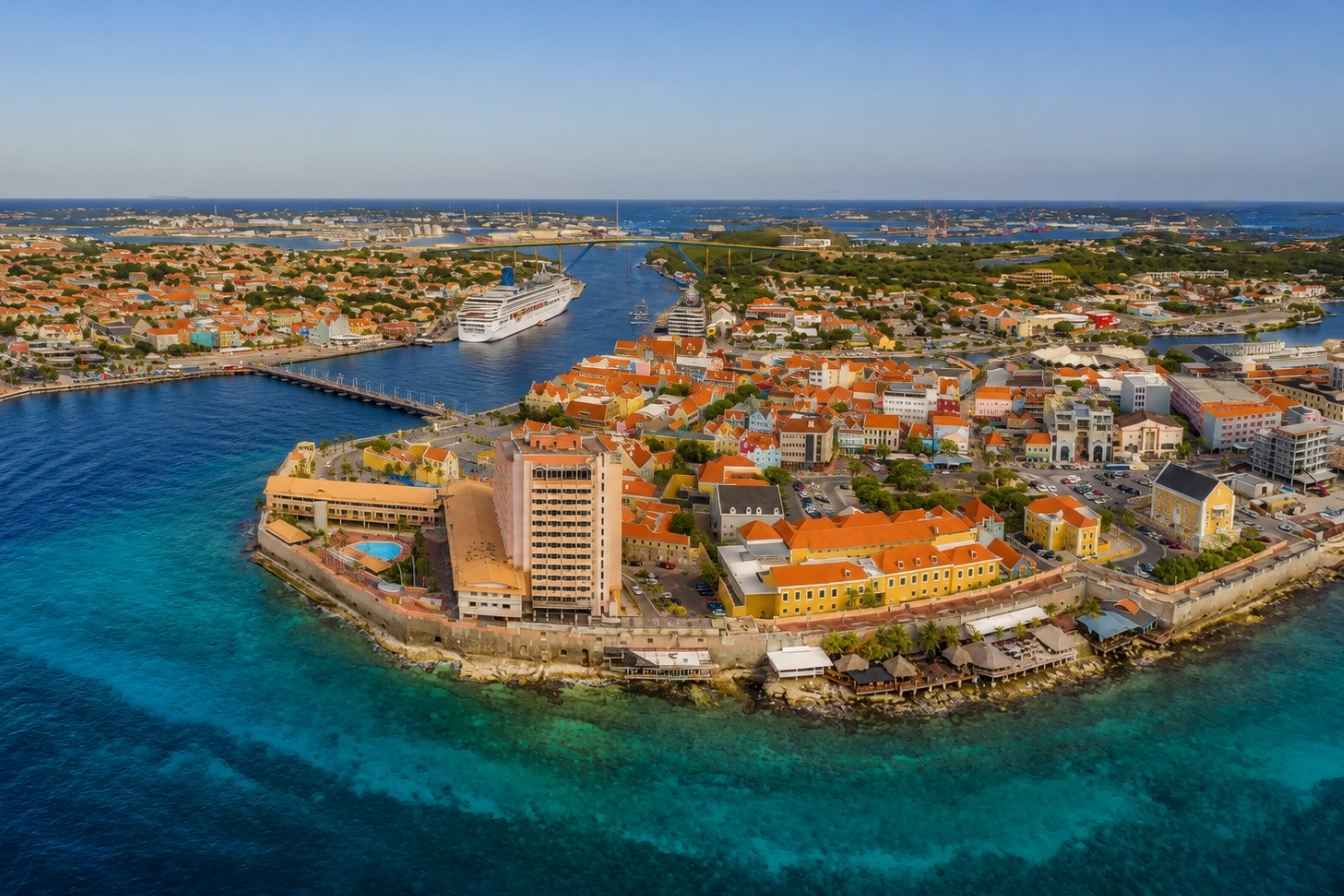
Everything worth seeing on foot clusters within about a kilometer of the bridge. You can loop Punda's shopping streets, cross to Otrobanda, take in the forts and the market, and circle back without ever feeling far from where you started. There is no need for a car, and no real need for a taxi within the historic core.
Timing depends on your appetite for detail. A brisk highlights walk fits a cruise stop; a slower day lets you sit at a market kitchen, step inside a museum, and photograph the murals. For where this fits in a wider trip, see our roundup of things to do in Curaçao and the city's role on a cruise-port day.
Distances stay small even when you wander. From the Handelskade to Rif Fort is a stroll of a few minutes once you cross the bridge, and the furthest quarters, Pietermaai to the south and Scharloo to the north, sit only a ten to fifteen minute walk from the center. There is no hill to climb and no traffic to fight, so the limiting factor is heat and curiosity, not stamina.
| District | Character | Do not miss |
|---|---|---|
| Punda | Shopping, colors, history | Handelskade, floating market, forts, synagogue |
| Otrobanda | Local life, art, forts | Rif Fort, Kura Hulanda, Brionplein, street murals |
| Pietermaai | Restored, boutique, nightlife | Cafes, colored facades, waterfront bars |
| Scharloo | Merchant mansions, big murals | Street-art wall, historic villas |
Is it safe to walk around Willemstad?
The tourist core of Willemstad, meaning Punda, Otrobanda along the waterfront, Pietermaai and Scharloo, is considered safe to walk in daylight with ordinary city awareness. Crime against visitors is low in these areas. As anywhere, keep valuables discreet in crowds, favor well-trafficked streets, and take a taxi rather than wandering unlit backstreets late at night.
By day the historic districts are busy, easy and relaxed, full of shoppers, cruise visitors and locals going about their business. The pontoon bridge, the shopping streets and the market are all comfortable to stroll solo, including for solo travelers. Common sense, not caution, is the right setting.
After dark, stick to the lively spots. Pietermaai's restaurant strip and the main waterfront stay busy into the evening and feel fine on foot, while quiet residential lanes a few blocks inland are better skipped at night. The same advice the island's official tourism board gives holds here: stay where the people are.
Petty opportunism, not violence, is the realistic concern, and even that is uncommon in the tourist core. Leave the flashy jewelry at the hotel, keep a phone in a front pocket rather than a back one, and you have covered the odds. Solo and female travelers regularly report the old town as one of the easier Caribbean capitals to explore alone by day, and the busy evening strips keep that comfort into the night.
How does the Queen Emma pontoon bridge work?
The Queen Emma pontoon bridge is a floating footbridge, first built in the late 1800s, that connects Punda and Otrobanda across the harbor mouth. It swings open many times a day, pivoting aside on the water to let ships pass, then closes again. Crossing is free, and when it is open, free ferries carry pedestrians across so you are never stuck.
Locals nickname it the swinging old lady, and watching it open is a small event in itself: a warning sounds, the gates close, and the whole span glides sideways under its own motors. If you time a crossing wrong you simply wait a few minutes or hop the ferry, so an opening is a photo opportunity rather than a delay.
The bridge is also the best free vantage point in the city. From the middle you get the classic view of the Handelskade facades lined up along the Punda waterfront. Cross it slowly, and cross it more than once, because the light changes the colors through the day.
There is a rhythm to catch if you can. Larger ships tend to pass around the start and end of the day as they enter or leave the harbor, so a mid-morning crossing usually finds the bridge closed and walkable. If you hear the warning horn while you are mid-span, you simply finish crossing before the gates shut, and if you miss it, the wait to watch the whole span glide open is a highlight rather than a hassle.
| Bridge fact | Detail |
|---|---|
| Type | Floating pontoon footbridge |
| Connects | Punda and Otrobanda across the harbor mouth |
| Opens | Many times a day for ship traffic |
| Cost to cross | Free; free ferry runs when it is open |
| Best for | The classic Handelskade photo |
What should you see in Punda?
Punda is the postcard side: the Handelskade row of pastel Dutch colonial houses, the Venezuelan floating market selling fruit and fish off moored boats, the government seat at Fort Amsterdam, and the Mikvé Israel-Emanuel synagogue, the oldest in continuous use in the Americas, with its famous sand-covered floor. It is also the main shopping quarter.
Start at the waterfront. The Handelskade is the most photographed spot on the island, a curving line of tall, narrow, brightly painted merchant houses reflected in the harbor. The story goes that a 19th-century governor blamed the glare of white walls for his headaches and ordered color instead, which is likely more legend than fact but fun to repeat.
From there wander inland. The floating market runs along the canal a short walk on, where boats from Venezuela sell produce and fish; Fort Amsterdam encloses a quiet courtyard and the tiny Fort Church; and the synagogue is worth stepping into for the sand floor alone. All of it belongs to the protected Historic Area of Willemstad, a UNESCO World Heritage Site.
Give yourself time to leave the waterfront and go a block or two inland. Punda's grid of shopping streets, anchored by the Breedestraat, mixes duty-free jewelers with old family shops and hidden courtyards, and the covered arcades offer shade when the sun bites. The district is small enough that getting pleasantly lost costs you nothing, and the quieter lanes behind the Handelskade often hold the details, doorways, shutters and tilework, that the crowds walk straight past.
| Punda sight | What it is | Time |
|---|---|---|
| Handelskade | Row of pastel colonial waterfront houses | 15 to 30 min with photos |
| Floating market | Venezuelan boats selling fruit and fish | 15 min |
| Fort Amsterdam | Government seat and Fort Church | 20 to 30 min |
| Mikvé Israel-Emanuel synagogue | Oldest in continuous use in the Americas | 30 min |
| Shopping streets | Breedestraat and the covered arcades | As long as you like |
What should you see in Otrobanda?
Otrobanda, literally the other side, is the more local, artistic half. Its highlights are the 19th-century Rif Fort, now a ring of shops and restaurants beside the Renaissance complex, the Kura Hulanda quarter built around a museum tracing the transatlantic slave trade, Brionplein square at the foot of the bridge, and a spread of street-art murals through its narrow lanes.
Where Punda polishes its shopfronts, Otrobanda shows its texture: winding alleys, restored townhouses, and walls given over to muralists. Rif Fort anchors the waterfront end, its old stone bastion repurposed into a lively courtyard of bars and eateries with harbor views, an easy first or last stop as you cross the bridge.
The Kura Hulanda complex is the district's cultural heart, a cluster of restored buildings around a museum that confronts the island's role in the slave trade, sobering and essential context for everything else you see. Between these landmarks, simply wandering Otrobanda's back streets turns up the best of the city's street art.
Otrobanda repays slow walking more than any other quarter. Its name simply means the other side, and it grew as the working counterpart to merchant Punda, which is why its streets feel lived-in rather than staged. Follow the murals from Brionplein up into the residential lanes and you pass barbershops, bakeries and old townhouses in every state of repair, a truer picture of the city than the postcard waterfront across the water.
| Otrobanda sight | What it is | Time |
|---|---|---|
| Rif Fort | 19th-century fort, now shops and restaurants | 30 to 45 min |
| Kura Hulanda | Museum on the transatlantic slave trade | 1 to 2 hours |
| Brionplein | Square at the foot of the bridge | 10 min |
| Street-art lanes | Murals through the back streets | 30 min wandering |
Where are the best photo spots in Willemstad?
The classic shot is the Handelskade waterfront from the middle of the Queen Emma pontoon bridge, best in morning light when the colors glow and the sun is behind you. Other winners: Rif Fort's harbor courtyard, the floating market's stacked produce, the murals of Otrobanda and Scharloo, and the whole skyline from the tall Queen Juliana road bridge above.
Light is everything with the colored houses. Early morning, before the cruise crowds and the harsh midday glare, gives you saturated pastels and soft shadows. Late afternoon works too as the sun swings around to light the facades warmly. Midday, straight overhead, is the least flattering hour.
For a different angle, the Queen Juliana Bridge, the high road bridge for cars, offers a sweeping view over the whole harbor and both districts, though you will want a taxi to reach it. Down at water level, the market boats and the mural walls give color without needing perfect light.
A few practical notes lift your shots. Include the bridge or a moored boat in the Handelskade frame for scale and a sense of place, rather than shooting the facades flat. Ask before you photograph market vendors, who are used to it but appreciate the courtesy. And carry a cloth for your lens, since the harbor throws spray and the tropical humidity fogs glass that has just come out of an air-conditioned cafe.
| Photo spot | Best light | Tip |
|---|---|---|
| Handelskade from the bridge | Morning | Sun behind you, before cruise crowds |
| Rif Fort courtyard | Afternoon | Frame the harbor through the arches |
| Floating market | Morning | Ask before photographing vendors |
| Otrobanda and Scharloo murals | Any | Shade keeps colors even |
| Queen Juliana Bridge viewpoint | Sunset | Reach it by taxi, whole skyline |
What about Pietermaai and Scharloo?
Pietermaai and Scharloo are the restored quarters just beyond the old-town core, and both reward a detour. Pietermaai, south of Punda, is a boho strip of boutique hotels, waterfront bars and colored facades that comes alive in the evening. Scharloo, across a bridge to the north, is lined with grand old merchant mansions and some of the city's biggest street-art murals.
Pietermaai went from crumbling to cool over the past couple of decades, and today it is where locals and visitors go for dinner and drinks. Its half-restored, half-weathered facades make it one of the most atmospheric places to walk at dusk, and it stays lively and safe into the night.
Scharloo is quieter and more architectural. Once home to wealthy Jewish and merchant families, its ornate villas range from beautifully restored to romantically faded, and its long mural wall is a highlight for street-art fans. Together the two quarters add an easy hour or two to a Willemstad walk.
The contrast between the two is the point. Pietermaai wears its revival openly, with cocktail bars and restaurants tucked into once-derelict mansions right on the sea wall, and it is the natural place to end a walking day as the light drops. Scharloo is more of a daytime detour for anyone who likes architecture and street art, its long mural wall and faded merchant villas quieter and less polished, which is exactly their charm.
A half-day walking route through Willemstad
Start on the Punda waterfront at the Handelskade in the morning light, browse the floating market and Fort Amsterdam, then cross the Queen Emma pontoon bridge into Otrobanda for Rif Fort and the murals. Loop back over the bridge, and if time allows, finish with lunch in Pietermaai. The whole circuit runs three to four hours at a relaxed pace.
This route keeps the sun at your back for the best photos early and saves the shaded lanes and lunch for the warmer middle of the day. Because everything connects on foot, you can lengthen or shorten it on the fly, adding the synagogue or the Kura Hulanda museum if you have the hours.
To go deeper than the buildings, join a small-group Willemstad food tour, which threads the same districts and the historic Plasa Bieu market with tastings a self-guided walk would miss. Pair this route with our traditional Curaçao food guide to know what to order along the way, and see the guided Curaçao tours we list for reaching the beaches afterward.
Treat the route as a frame, not a rulebook. If a bridge opening holds you up, duck into the market or a cafe until it closes, and if the heat climbs, move your inland wandering to the shaded arcades and save the exposed waterfront for later. The beauty of a city this compact is that no wrong turn costs you much, and the best moments, a quiet courtyard, a mural you did not expect, a vendor's recommendation, tend to be the unplanned ones.
| Stop | Time | Notes |
|---|---|---|
| Handelskade waterfront | Start, morning | Classic photos in good light |
| Floating market and Fort Amsterdam | +45 min | Produce boats, quiet courtyard |
| Cross the pontoon bridge | +15 min | Stop mid-span for the view |
| Rif Fort and Otrobanda murals | +1 hour | Shops, street art, harbor views |
| Lunch in Pietermaai | +1 hour | Optional finish, waterfront cafes |
When should you go, and what should you bring?
Walk Willemstad in the early morning or late afternoon to dodge the midday heat and the thickest cruise crowds, which peak when several ships are docked between roughly November and April. Bring water, reef-safe sun protection, a hat, and comfortable shoes for the uneven historic pavements. Little cash covers the market and snacks; cards work in shops.
The city is at its calmest and prettiest first thing, before the tour groups arrive and while the light is soft. If you are here on a cruise day, going against the crowd, city first thing or late in your window, makes a real difference to how relaxed the walk feels. Our best time to visit Curaçao guide covers the wider seasonal picture.
Comfort is mostly about heat and feet. The sun is strong and shade is patchy, so hydrate and cover up, and the old stone pavements and occasional steps mean sandals with grip beat flip-flops. With that sorted, Willemstad is as easy and rewarding a city walk as the Caribbean offers.
One last comfort note for cruise-heavy days: check how many ships are in port before you set out. Two or three large vessels can put thousands of extra people on the same few streets between mid-morning and mid-afternoon, so if your schedule is flexible, walk early or late and let the crush pass. The waterfront that feels shoulder-to-shoulder at noon is calm and photogenic again by four.